

Creating a harmonious, balanced, and calming living environment is the purpose of feng shui, and the principles could help improve the feel of your space both outside and inside.
The Basic Principles of Feng Shui
Chi
Chi is the life energy we experience and can be either positive or negative. Whether the chi you experience is positive or negative is a feeling you’ll experience intuitively. Places that make you feel comfortable have good chi – think of an example to draw inspiration from. Usually, positive chi has a strong connection to nature, for example, natural light, curved edges, etc.
Five Elements
The five elements in feng shui are fire, earth, metal, wood, and water. These elements each have different characteristics, shapes, and colours, which bring aspects or energies uniquely their own. These can accentuate different parts of your life.
- Fire: The element of passion, energy, and emotion. It is associated with warm colours like red and orange. It’s represented in the shape form by triangles.
- Earth: The element of stability and balance. It is associated with earthy colours like browns and rock-like textures. You may find this element in places like terracotta pots in a potting shed. It’s represented in the shape form by squares.
- Metal: The element of focus, clarity and strength. It is associated with metallic and pastel colours like silver and white. Tech and electronics fall under the metal element. It’s represented in the shape form by circles.
- Water: The element of movement and flow. It is associated with colours like blue and black. This element doesn’t have to be represented by the actual presence of water; glass and mirrors also represent it. It’s represented in the shape form by swirling patterns.
- Wood: The element of growth and vitality. It is associated with colours like green and images like leaves and flowers. This element is excellent for boosting creativity. It’s represented in the shape form by rectangles.
Commanding Position
The command position in a room is where to place key pieces of furniture to help you feel secure and in control. Having the focus piece of furniture for the room, for example, a desk in an office or a sofa in a lounge, with a solid wall behind and a clear line of sight to the door, without sitting directly in line with the door, is the best position. Finding the purpose of your space helps in decorating your space and discovering your focus piece.
Bagua
Bagua is a map which you can overlay on the floor plan of a room to visualise which sections of the room represent which aspects of your life. You can orient your bagua to the main door of the room by rotating the bottom of your bagua map to the side of your floor plan with the door on. This helps you determine which part of your space relates to different aspects of life. You can then add certain aspects to each area based on what that space promotes.
Feng Shui for Gardens
You can apply the principles of feng shui to your garden in a similar way to how you would for your home. It may even be simpler, especially when implementing some elements like wood and water, in that it can be easier to introduce shrubbery and water features in your garden.
Which Garden Buildings are Complementary to Garden Feng Shui?
Garden Sheds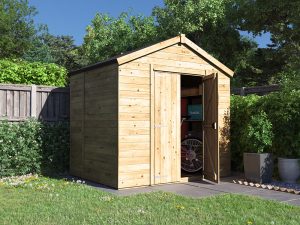
Removing clutter is an important part of feng shui as clutter blocks the flow of good chi. Sheds are excellent at helping with the removal of clutter. If it is organic material like leaves and dead plants, you can keep the tool you’ll need to remove them, and if it’s your belonging the shed can be used for storing them neatly.
Pergolas and Gazebos
Create sections for yin and yang by using pergolas and gazebos to create a balance between sun and shade. This helps make your garden feel more harmonious.
Potting Sheds
Having healthy plants in your garden represents growth, and a potting shed is an excellent way to help grow more plants that thrive. Certain plants are considered lucky, such as lavender, citrus trees, bamboo, etc.
Feng Shui Tips for Different Garden Buildings
Log Cabins
Log cabins are flexible and adaptable, which means they can be used for many things, but don’t let that distract you too much from the intended purpose of your log cabin, as this can lead to a room which is harder to incorporate feng shui into the design of. Alternatively, you could consider a multi-room log cabin, which would allow distinct spaces with their own purposes. This way, you’ll know what elements to add to enhance each space.
Garden Office
For your garden office, place your desk in the command position of the room to help you feel stable and focused. With a modular garden office, you get more freedom with your office design. This means you have more flexibility to place your windows and doors at convenient locations, so you have your office oriented the way that works best for you.
Get in touch
If you’d like more information on our range of garden buildings, please contact us through our contact us page or by calling us on 01234 272445.
 Back to blog