

Britain’s gardens, garages, spare bedrooms and kitchen tables are increasingly becoming fully functioning workplaces. Across the country, people are turning home-run enterprises into full-time careers and significant sources of income, from yoga studios in converted stables to creative agencies operating out of garden offices and reflexology practices housed in repurposed garden sheds.
New research commissioned by Dunster House reveals how UK entrepreneurs are transforming their homes and outdoor spaces into professional business hubs. The findings paint a fascinating picture of a workforce in transition, one that is choosing autonomy, flexibility and proximity to family life over the traditional commute, the open-plan office and the commercial lease.
This report explores why people are choosing to run businesses from home, the lifestyle and financial realities behind the decision, the challenges of separating work and personal life, and how Britain’s gardens are increasingly being designed for productivity as well as relaxation.
The rise of the home business
Home-run businesses in the UK are no longer simply side hustles or passion projects kept quietly alive at evenings and weekends. For a growing number of entrepreneurs, they represent long-term, financially significant enterprises that are reshaping both domestic life and the wider economy.
Our research, conducted among 250 UK adults who run their business fully from their home, a small garden office or outdoor workspace, reveals that 46% say their enterprise is critically financially important and their primary source of income. Combined with those who rely on it for significant additional earnings, nearly three-quarters (74%) describe their home business as either their main income source or a substantial financial contributor.
At the same time, 62% have invested money specifically into home or garden offices, or a home workspace to support their business, while 14% cited the prohibitive cost of commercial renting as a key reason for operating from home. That figure carries significant weight when viewed against wider market conditions: according to data from Savills, prime office rents in major UK regional markets have increased by approximately 32% over the last five years, making the commercial route increasingly inaccessible for early-stage and independent operators.
The motivations behind this shift are telling. Nearly half of respondents (47%) started their business in pursuit of a better work-life balance, while 36% wanted to work from home by design, and a further 36% sought greater flexibility in how and when they worked. These are not responses to failure or redundancy alone; they represent an active and considered rejection of the conventional employment model in favour of something more aligned with personal values and domestic priorities.
The new face of Britain’s home business economy
Britain’s home business community is far more diverse than popular perception might suggest. While online retail and e-commerce account for the largest share of activity at 17%, the survey reveals a remarkably varied landscape of enterprise.
| Business Type | % of respondents |
|---|---|
| Online retail or e-commerce | 17% |
| Creative and freelance professional services (graphic design, photography, marketing, copywriting) | 14% |
| Tutoring, coaching and education (academic tutoring, music lessons, language teaching) | 9% |
| Arts, crafts and handmade products (jewellery, candles, pottery, artwork) | 7% |
| Beauty and wellness services (hair, nails, lashes, massage) | 7% |
| Content creation and social media (influencer work, streaming, podcasting) | 7% |
| Fitness, yoga and personal training |
7% |
| Other | 20% |
The diversity of that final category is particularly significant. The 20% who describe their business as something other than the options listed above reinforces just how broad the backyard economy has become, spanning fields as varied as consultancy, tourism, legal services and financial advice.
Younger generations are driving a distinctly digital and creator-led strand of this activity. Among 18 to 24-year-olds, 29% run online retail or e-commerce businesses compared with just 14% of those aged 55 and over. Among 25 to 34-year-olds, 12% run content creation or social media businesses, and a further 12% operate in fitness, yoga or personal training. For many younger entrepreneurs, the backyard business is not a fallback but a first choice, and it is increasingly digitally native in both its model and its reach.
Case Study: Carole Barker
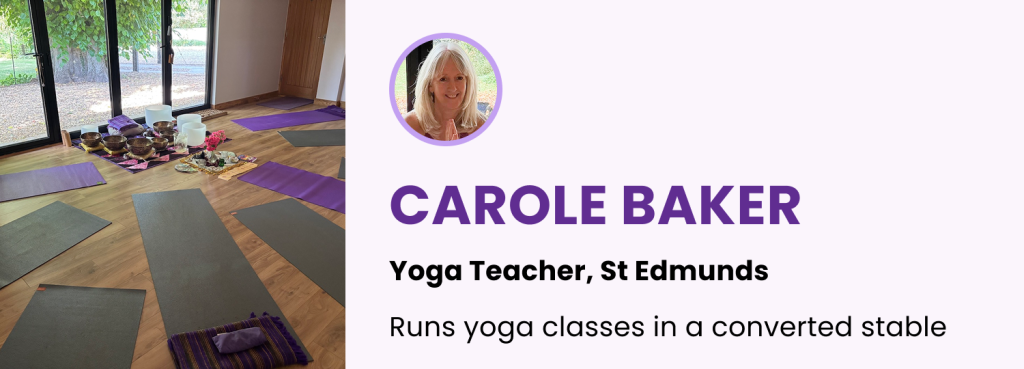
Yoga teacher, sound healer and wellness practitioner | https://carolebaker.co.uk/
Carole Baker runs her wellness business from a converted stable set within a three-acre garden in Bury St Edmunds. After selling a successful commercial wellness centre she founded in 2005, the overheads of rent, rates, staffing and operational management led her to rethink the model entirely.
“I went from teaching classes of 18 to a home studio that only took four mats and me, right next to a railway line where I had to stop talking when a train went past,” she says. “Today, my studio takes a maximum of seven, in the shade of a 300-year-old lime tree with only the sounds of the countryside around. It was the right call.”
Carole’s commute is now a stroll across the garden. She offers yoga, sound baths, breathwork, wellness advice, private sessions and day retreats, with her clients predominantly women aged from their early twenties to nineties. She has plans to expand into bespoke retreats, a classroom wellbeing programme for primary school children, and an online chair yoga programme.
Her one piece of advice for anyone considering taking the same step: “It can take over your life if you let it.”
Why Brits are choosing backyard businesses
The research makes clear that the decision to run a business from home is increasingly a lifestyle one rather than purely a financial calculation. When asked what motivated them to start their home-based enterprise, respondents pointed overwhelmingly to personal priorities over economic necessity.
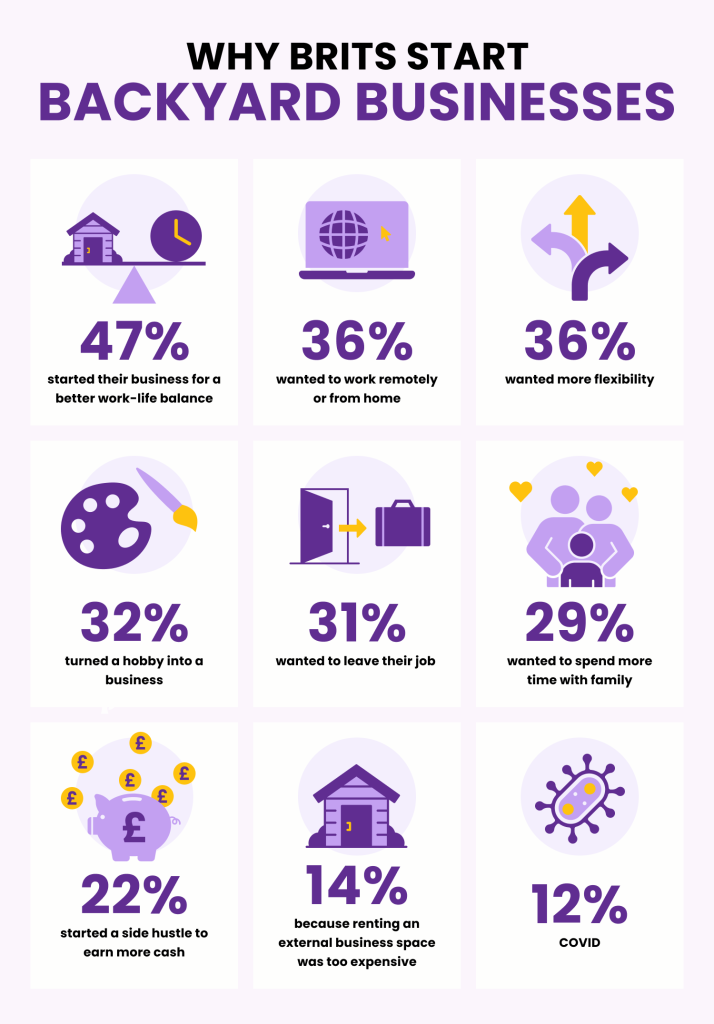
For younger generations, the impetus leans strongly towards passion and purpose. Among 18 to 24-year-olds, 53% turned their hobby into their business, more than double the rate seen among those aged 55 and over (22%). Among millennials aged 35 to 44, work-life balance is the defining motivator, cited by 60% as their primary reason for choosing this path.
The demographic picture of home business ownership is also instructive. More than a third (38%) of the survey sample are married with children, and a further 15% are in a relationship and have children. Many are balancing entrepreneurship alongside the school run, childcare and the everyday rhythms of family life. Seventy-two per cent of those who operate from their garden are property owners, reinforcing the connection between home ownership and the ability to invest in and adapt a workspace.
Case study: Adele Locker
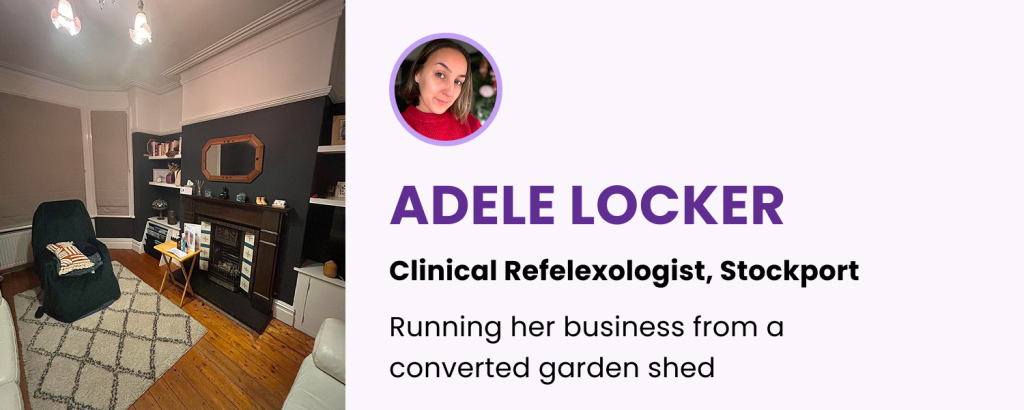
Clinical Reflexologist, Mindful Sole | https://mindfulsole.co.uk/
Adele Locker is an accredited clinical reflexologist running Mindful Sole Reflexology from a converted garden shed in Stockport. What began as a family shed used for a music room is now a dedicated therapy space where clients come to address stress, anxiety, menopause symptoms, chronic fatigue, fertility journeys and a wide range of other health concerns.
“My husband had a music room in our garden shed and suggested moving his equipment into the cellar,” Adele explains. “Together, we transformed the shed into a dedicated therapy room. What was once a simple garden building became a peaceful retreat where clients can step away from the stresses of everyday life.”
Adele’s path to reflexology began during her first pregnancy, when she experienced the treatment and was deeply affected by how calm and grounded it made her feel. Following the birth of her children during lockdown, she enrolled in a Level 5 Clinical Reflexology qualification and began building the business around family life, working three days a week to accommodate school runs and home responsibilities.
Her advice to those starting out? “Don’t overthink the space. I spent so much time worrying about creating the perfect treatment room when, in reality, clients come because of you and the service you provide. Creating a warm, welcoming and safe environment is far more important than expensive decor or having everything look picture-perfect.”
HQ: where Brits are running their businesses
While the polished garden office dominates social media feeds, the reality of Britain’s home business landscape is rather more varied. The most common workspace is the study or home office (20%), but a substantial proportion of entrepreneurs are running their businesses from wherever space allows: the living room (14%), a summer house or garden room (10%), a spare bedroom (10%), a workshop or studio (9%), a garage (6%), or even the kitchen or dining table (6%).
Britain’s homes, in short, are quietly becoming multi-functional workplaces, adapted and repurposed with resourcefulness rather than renovation. The garden, however, is playing an increasingly significant role. One in ten home business owners already operates from a summer house or garden room, reflecting a broader trend towards outdoor office investment that the data suggests is only set to grow.
The hidden downsides of running a business from home
The freedom and financial advantages of home-based entrepreneurship come with a less discussed set of challenges. Despite the flexibility and reduced overheads, many home and garden business owners admit that the boundaries between professional and personal life are harder to maintain than they anticipated.
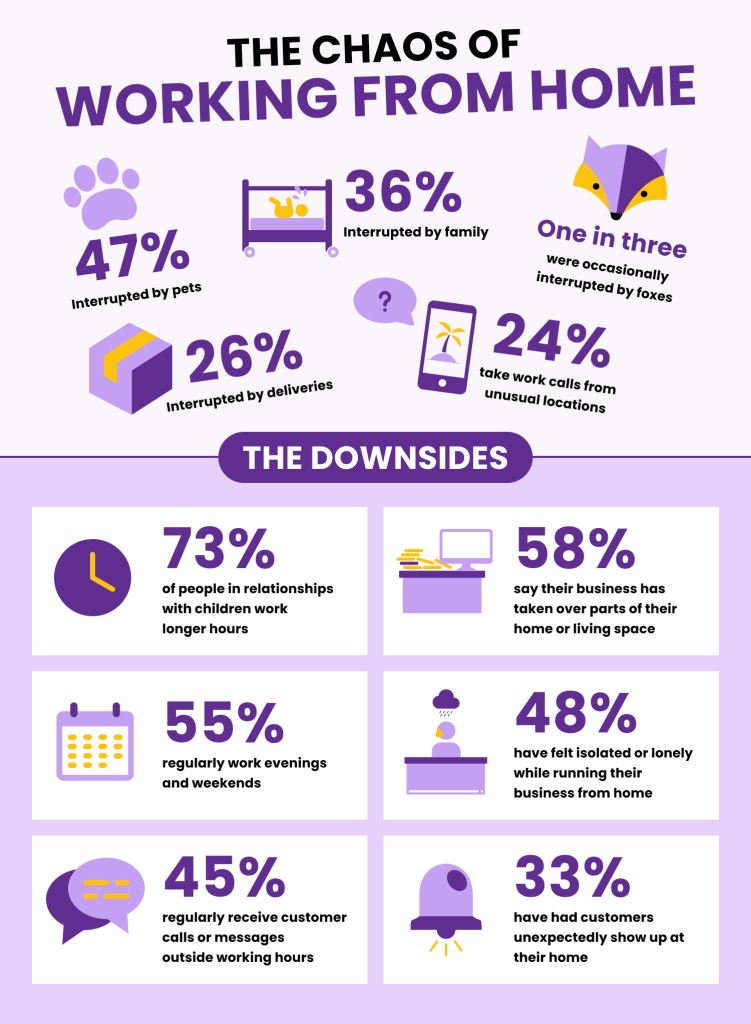
The picture is particularly demanding for those balancing business ownership with parenting. Among respondents in relationships with children, 73% regularly work longer hours than they did in traditional employment, and 68% of those aged 35 to 44 work evenings and weekends on a regular basis.
Isolation, meanwhile, is a challenge that is easy to overlook but difficult to overstate. Nearly half of all respondents (48%) have felt lonely or isolated while running their business from home. This rises to 25% of those without children and as high as 40% among those who live with family, suggesting that physical proximity does not always translate into the sense of professional community and social connection that an office environment provides.
And then there are the interruptions. Fifty-three per cent of home business owners report pets disrupting their working day, 36% regularly experience family interruptions, 26% are frequently interrupted by deliveries, and one in three working among nature say that foxes are an occasional occupational hazard.
How to create boundaries when your office is only ten steps away
Alastair Wallace, CEO and Lead Consultant at Brainfood Ltd, a London-based leadership and management training company, runs his business from a kitchen table in North West London, and is uniquely placed to reflect on the practical and psychological realities of home-based working.
“When your commute is ten steps, it is very easy to never quite arrive at work and never quite leave it either. You think you will just reply to one email, and suddenly it is 9.47pm and you are still in business mode, only now with slippers on.”
Alastair Wallace, CEO and Lead Consultant, Brainfood Ltd
Wallace acknowledges the challenges reflected in the survey data directly. He points to the absence of physical separation as the primary culprit: without a commute or a defined office environment, the cues that signal the transition between work and home life simply do not exist. “Your home starts guiltily whispering ‘work’ at you from every corner,” he says.
His response is to create deliberate structure. “I use clear start and stop rituals, proper breaks, focused blocks of work, and a very simple rule: if everything is urgent, nothing is being led properly. Everything has a slot in my diary.” He recommends a ‘shutdown’ routine at the end of each working day, physically clearing the workspace and resetting the space to signal to the brain that work is over.
On the question of credibility, Wallace is clear. “Professionalism is behaviour, not postcode. Clients care whether you understand their problem and can help them solve it. Good tech, clear communication, and useful follow-up make a bigger impression than an expensive office.”
He also addresses the issue of isolation directly: “Stay connected. Isolation is real when you work from home, so schedule conversations, networking, collaboration and in-person work. Humans are not designed to be inbox goblins.”
Case study: Gareth Robertson
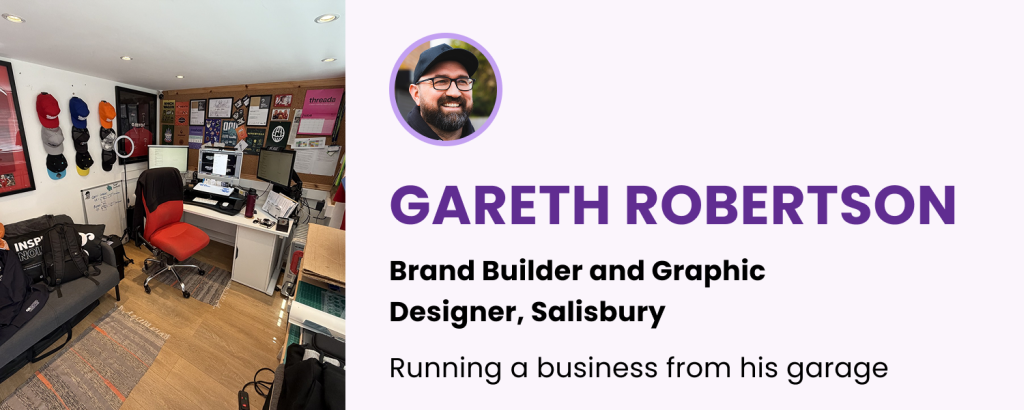
Brand builder and graphic designer, Gr-aphic Studio | http://www.gr-aphic.uk/
Gareth Robertson runs Gr-aphic Studio, a branding and design practice, from a converted garage in Salisbury. He has been self-employed for nearly 15 years and is emphatic about the financial logic of his current setup.
“For the space I have here in my garage, I’d be paying at least £500 a month in rent,” he says. “So here, it costs me nothing other than the electric to run everything.”
The garage arrangement offers one significant psychological advantage over a home office. “It is easier working in the garage studio as this is separate from the main house. I have to leave the house to walk down the garden to work,” he explains. “But the temptation to just answer one more email is always there.”
Gareth also acknowledges one of the more unexpected challenges of home-based business: managing the perception of professionalism when clients look you up online. His practical advice has a wry edge: “I’d love to know how to get my home address off my Google listing. As I work with clients all over the world, my physical location is not really relevant.”
His current projects include building an online academy for designers and developing a new clothing brand for fathers, both conceived and developed from that same garage in Salisbury.
The dream backyard business: what home entrepreneurs really want
Despite the challenges, home business owners are not simply tolerating their current setups. Many are actively investing in them, and looking ahead to significant improvements. The survey finds that home business owners have invested an average of £5,170 into their workspace, with more than a third (36%) having invested at least £5,000.
| Investment band | % of respondents |
|---|---|
| Up to £499 | Less than 19% |
| £500 to £1,999 | 26% |
| £2,000 to £4,999 | 20% |
| £5,000 to £9,999 | 19% |
| £10,000 to £19,999 | 15% |
| £20,000 or more | 2% |
When asked what they would invest in if money were no constraint, the answers point strongly towards workspace quality and professional infrastructure. Better broadband or Wi-Fi tops the list (34%), closely followed by improved heating or air conditioning (34%) and a fully insulated garden office (32%). Dedicated storage space (28%), a larger workshop (27%), soundproof studios (21%) and smart technology or security systems (21%) also feature prominently.
The appetite for a dedicated, insulated garden office is particularly significant. A purpose-built outside office resolves many of the most common frustrations at once: it creates the physical separation between work and home life that so many home business owners struggle to achieve, provides a professional environment for client interactions, and removes the need to sacrifice domestic living space to the demands of the business.
For those considering a dedicated garden building, the range of garden offices at Dunster House includes insulated, year-round options designed for exactly this purpose. From compact studio offices to larger composite and rendered structures, they are built to create the kind of permanent, professional separation that home business owners increasingly recognise as essential.
Case study: Alice Jordan
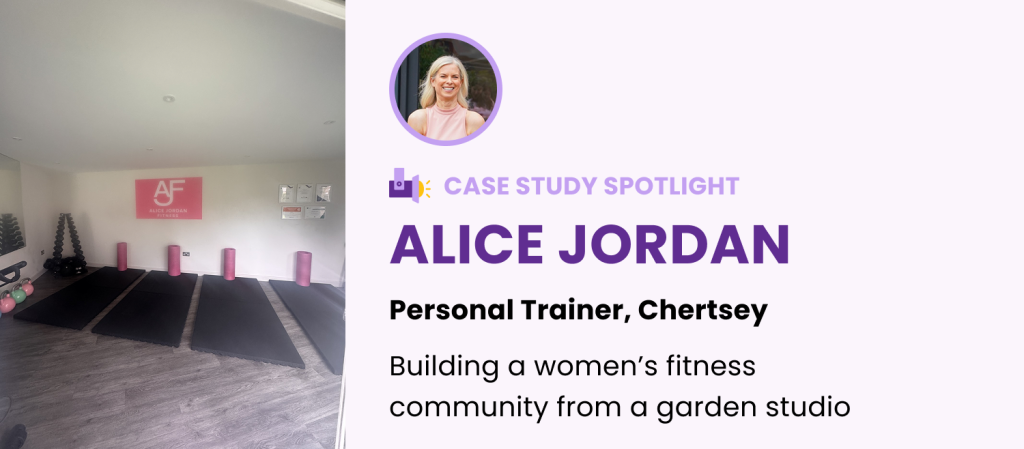
Personal trainer and menopause coach, Alice Jordan Fitness | https://www.instagram.com/alicejempowered/
Alice Jordan is a 52-year-old mum of three who left a corporate sales career of more than 20 years and, after being made redundant, spent lockdown studying for her personal training qualifications. She now runs 10 group fitness classes a week from a dedicated garden studio in Chertsey, Surrey, with up to 10 women per class, alongside one-to-one sessions and online coaching through a dedicated app.
The decision to build a garden studio was driven by a desire to create an environment that felt nothing like a conventional gym. “Many women, including myself, can feel intimidated walking into a gym environment,” she says. “I wanted to create a community where women could meet like-minded people, exercise without judgement and feel comfortable being themselves.”
“Clients often tell me that training in a garden studio feels much less intimidating than walking into a commercial gym, and the outdoor setting creates a relaxed, friendly atmosphere. It has become a place where women can focus on themselves, build confidence and enjoy exercising alongside others who are on a similar journey.”
Her goal is to continue growing both the in-person studio and the online programme, ultimately reaching women across the UK and beyond who need specialist support through perimenopause and menopause.
The backyard economy: a shift that is here to stay
The evidence from this research points to something more durable than a post-pandemic trend. Britain’s gardens and home spaces are being permanently reimagined as places of work, creativity, commerce and professional practice. The motivations are genuine and the financial stakes are high. For the majority of people in this survey, this is not a lifestyle experiment; it is how they earn their living.
The challenges are real too. The blurring of work and home life, the isolation, the storage constraints and the pressure to appear credible in the eyes of clients and customers are all legitimate pressures that do not resolve themselves without deliberate effort and, in many cases, investment in a better physical workspace.
What the data makes clear is that many home business owners already know what the solution looks like. The demand for insulated garden offices, dedicated workspaces and purpose-built studio buildings reflects a mature understanding of what it takes to run a serious business from home. A well-designed outdoor workspace creates the separation, the professionalism and the permanence that makeshift domestic arrangements cannot provide.
Explore Dunster House’s full range of garden offices, built for year-round use and designed to give your business the space it deserves.
Meet the expert
Alastair Wallace, CEO and Lead Consultant at Brainfood Ltd, is a London-based leadership and management training specialist who has trained and developed more than 23,500 leaders and managers across the UK and internationally. He runs his own business from a kitchen table in North West London.
Methodology
The research was conducted by Censuswide among 250 UK adults aged 18 and over who are business owners or sole traders and run their business fully from their home, garden or outdoor workspace. The survey was carried out between 27th May and 29th May 2026.
 Back to blog